Burst & Frozen Pipe RepairSouth Central PA
Central Pennsylvania winters write the same story every year. A cold snap settles in for three nights, wind finds the rim joist of a house in Hanover or a crawl space vent in Ephrata, and a pipe that survived a decade of winters freezes solid. The cruel detail of frozen pipes is that the burst often announces itself later, at the thaw, when the ice lets go and the split opens at full pressure.
Typically $180–$750
Burst and frozen pipe repair is two skills. The first is safe recovery: stopping the water, thawing a frozen line without splitting it further or setting anything on fire, and finding every split, because a hard freeze rarely breaks a pipe in only one place. The second is a repair that addresses why that spot froze, insulation, a sealed air leak, a rerouted line, so next January is quieter.
In this corridor the work typically costs $180–$750 depending on how much pipe failed and where it hides. The range is stated when you call, along with the shutoff steps that limit the damage while you wait.
Frozen, burst, or about to be
One tap dead on a cold morning
A single faucet, usually on an outside wall, producing nothing or a trickle while the rest of the house runs, is a frozen section announcing itself. The pipe has not necessarily split yet. This is the cheapest moment to act.
Frost on an exposed pipe
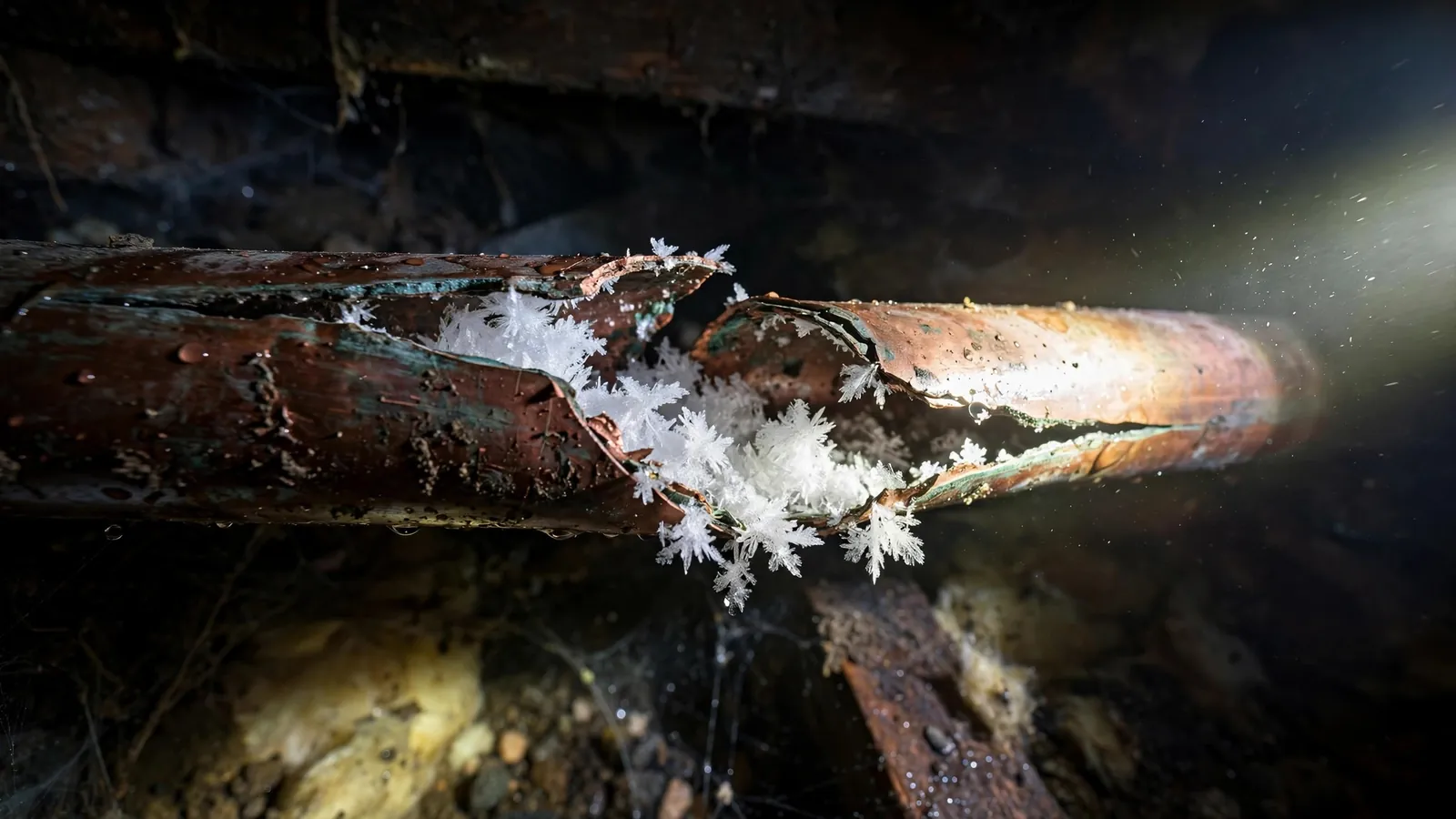
A white frost coating on a basement or crawl space line means the pipe wall is at freezing temperature and the water inside is close behind. Treat frost like a fire alarm: heat the space gently and find why cold air is reaching the pipe.
A bulge in the line
Ice expands with enough force to swell copper before it splits. A section that looks pregnant is a burst that has not opened yet. Do not squeeze, strike or torch it; call and keep the main valve location in mind.
Water appearing as the day warms
The classic thaw leak: fine at dawn, dripping by lunch, spraying by dinner as the plug melts. If a pipe froze overnight and the day is warming, walk the house and check ceilings and walls under bathrooms before the water does it for you.
A sudden pressure drop
Taps running weak across the house after a freeze, or the well pump or meter running when nothing is open, means a split is pouring somewhere hidden: a wall cavity, a crawl space, under a slab.
Discolored water after the thaw
A burst stirs sediment and sometimes soil into the line. Brown water at one tap after a freeze event is a symptom to report on the call; it helps locate which run failed.
How frozen and burst pipes get fixed
Step 1
Stop the water, open a tap
The main valve closes first. Then a faucet on the frozen run opens to relieve pressure and give melting ice somewhere to go, which alone prevents some splits. If the pipe has already burst, the area is made safe: power off to soaked circuits, belongings moved.
Step 2
Thaw gently, from the tap backward
Frozen sections are warmed with controlled heat: a hair dryer, heat tape, warm towels, a space heater at a safe distance. Never an open flame, which scorches pipe, ignites framing dust, and voids insurance. Thawing proceeds from the faucet toward the frozen blockage so pressure never builds behind ice.
Step 3
Find every split
Once flow returns, the whole run is inspected and pressure tested. A freeze that split one elbow often cracked another joint two feet away, and a repair that misses the second break is a second flood scheduled for the next cold night.
Step 4
Repair and freeze proof
Damaged sections are cut out and rejoined in copper or PEX, then the cause is addressed: pipe insulation fitted, the air leak at the rim joist or vent sealed, a hose bibb drained, or in stubborn spots the line rerouted inside the warm envelope of the house.
What burst pipe repair costs in Central PA
A single split in an accessible basement line, cut out and rejoined, sits near the bottom of the $180–$750 range. Thawing a long frozen run without a burst costs less than repairing one, which is the financial argument for calling at the frost stage instead of the flood stage.
The price climbs when several splits hide in one freeze, when the failed section runs inside a finished wall or ceiling that must open and later be patched, and when the call comes at 3 a.m. in the coldest week of the year, which is when these calls honestly do come. Water damage, as always, outbills the plumbing if it is given time.
Frozen is urgent; burst is an emergency
A frozen pipe with no leak yet deserves a same day call, because you are racing the thaw. A burst pipe deserves the emergency sequence: main valve closed, power made safe, then the call. If you cannot find or move the main valve, say so immediately; the call taker knows the meter shutoff options for the corridor's utilities.
While you wait, do not pour boiling water on a frozen pipe, do not chip at ice with a screwdriver, and do not leave space heaters running against a wall unwatched. Gentle heat and patience save more pipes than force does.
Burst & Frozen Pipe Repair in these towns
Burst & Frozen Pipe Repair: questions homeowners ask
Will a frozen pipe always burst?
No. Many frozen pipes thaw without splitting, especially PEX, which expands and recovers. Copper and CPVC are less forgiving. The danger zone is a hard freeze held for many hours. Either way, a pipe that froze once sits in a spot that freezes, and freeze proofing that spot is part of a proper visit.
How can I keep pipes from freezing tonight?
Open cabinet doors under sinks on outside walls, let vulnerable taps drip a pencil thin stream, keep the thermostat at its normal setting overnight, and close crawl space vents. Garden hoses should already be off and drained. These steps are cheap and they work on most houses in most cold snaps.
At what temperature do pipes freeze here?
There is no single number, because wind and insulation matter more than the thermometer. The risk climbs when temperatures hold in the teens or below for a night, and uninsulated pipes in windy crawl spaces can freeze at higher readings. Local experience says the dangerous nights in this corridor are the ones forecast under 20 degrees with wind.
My pipe burst while I was away. What now?
Close the main if it is not already, switch off the water heater, and photograph everything before cleanup for the insurance claim. Call for the repair, and ask the plumber to check the whole system under pressure, because a house that froze in one place often froze in three. A plumber's report on cause helps the claim.
Should the repaired section be insulated?
Yes, and insulation alone is sometimes not enough. If the pipe froze because cold air pours through a rim joist gap or an open vent, the air leak must be sealed or the insulation just delays the next freeze. The repair visit should leave the spot warmer than it was found, by insulation, sealing or rerouting.