Sewer Line RepairSouth Central PA
The sewer lateral is the hardest working pipe you own and the one you think about least: a single line, usually four inches around, carrying everything out of the house to the street or a septic tank. In this corridor much of that pipe is old. Vitrified clay with joints every few feet, cast iron that scales and cracks, and in some postwar neighborhoods a tar-paper pipe called Orangeburg that is now decades past its design life.
Typically $1,300–$5,800
Sewer line repair is therefore not one job but a family of them, and the honest sequence is always the same: clean the line, put a camera in it, and then choose the repair that matches the damage. A spot excavation over one crushed joint, a trenchless liner through a root-riddled but round pipe, a full replacement for a line that has bellied or collapsed. The prices differ by thousands, and the camera is what keeps you from buying the biggest one by default.
Across South Central Pennsylvania, sewer line repair typically costs $1,300–$5,800 once the diagnosis is in. Anyone who quotes a replacement over the phone without seeing the inside of your pipe is selling, not plumbing.
What a failing sewer line looks like from inside the house
Backups that return after cleaning
A main line that needs clearing again within months is not a cleaning problem anymore. Roots regrow, a belly in the pipe collects solids, or a joint has offset enough to catch everything that passes. The pattern is the diagnosis.
Several drains misbehaving together
The basement floor drain, the first floor toilet and the tub all slow at once because they share one exit. When the whole house drains badly, the problem lives between the house and the street.
A strip of yard that sinks or stays lush
Escaping sewage waters and fertilizes the soil above the line, and leaking joints wash soil away until the ground settles. A green stripe in a dry month, or a dip you can feel with the mower, traces the pipe's path.
Sewer smell outdoors
Odor near a cleanout, along the line's path, or in a basement with no backup yet can mean a cracked vent section or a joint leaking gas before it leaks water. Smell is an early symptom; treat it as one.
Foundation and floor cracks near the line
A leaking lateral under or beside a slab erodes the soil supporting it. New cracks in a basement floor or a slab corner that drops are sometimes a plumbing problem wearing a structural costume.
Old pipe materials in an old house
If your house predates 1975 and the lateral has never been replaced, the pipe is clay, cast iron or Orangeburg, and it is living on borrowed time whether it has complained yet or not. A camera look during a calm season beats an emergency excavation in a wet one.
From first backup to finished repair
Step 1
Clean the line so the camera can see
A camera pushed through a packed line shows nothing but the clog. The line is machined first, roots cut and solids cleared, so the inspection that follows is worth paying for.
Step 2
Camera inspection with locating
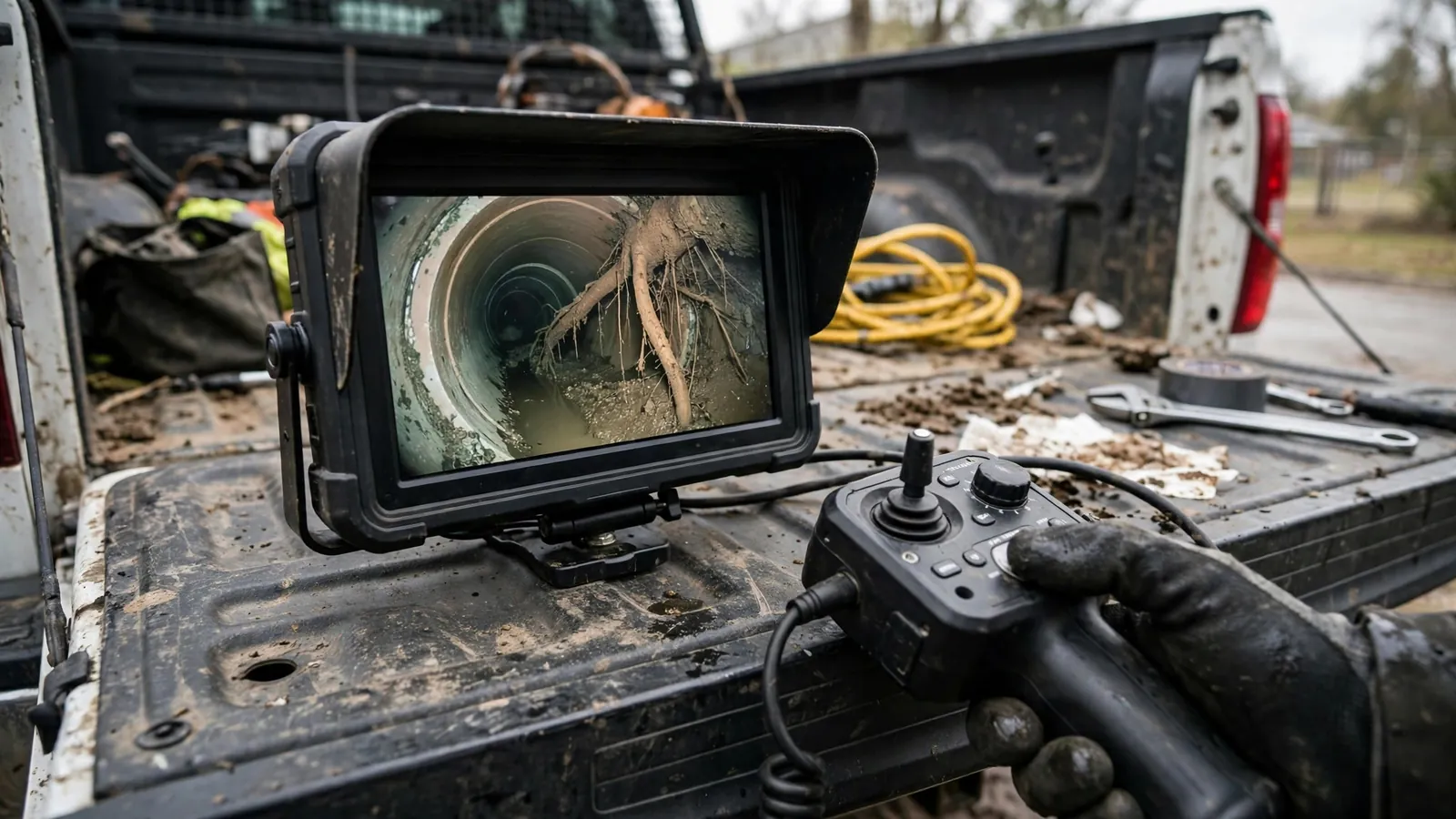
The camera travels the full lateral while a locator above ground marks its path and depth on your lawn. You can watch the screen: roots at a joint, a belly holding water, a crack, a collapse. The footage is the evidence every later decision rests on.
Step 3
Options priced side by side
Spot excavation over one bad joint. A trenchless liner that rebuilds the pipe from inside where the host pipe is sound enough. Full replacement where the line has failed along its length. Each is priced, with its disruption described honestly, and the recommendation explained in terms of the footage you just saw.
Step 4
Repair, inspection and restoration
The chosen work is done under the borough or township's permit and inspection where required. The line is camera checked again after the repair, the trench is backfilled and settled areas are flagged for a return tamp if they sink, and the system is tested with every fixture in the house running.
What sewer line repair costs in this corridor
Once the camera has spoken, most repairs here land between $1,300 and $5,800. The bottom of the range is the friendly case: a single damaged joint, shallow, in open lawn, repaired by spot excavation in a day. The middle covers longer excavations, deeper lines, and trenchless lining of a typical residential run. Full replacement of a long, deep lateral under obstacles sits at the top.
Depth and surface drive cost more than pipe does. A line four feet down in grass is a different job from the same line seven feet down under a driveway, a porch or a mature tree that must be worked around. That is why the locator pass matters: price follows the actual path of your pipe, not a guess from the curb.
A sewer problem sets its own deadline
A line that backs up sewage into the house is an emergency today; stop using water and call it in. A line that is merely slow, or that a camera shows to be cracked but flowing, gives you days to a few weeks to choose a repair properly, get the footage explained, and compare the options with a clear head.
What you should not do is nothing. Clay joints do not reseal, roots do not retreat, and Orangeburg does not get rounder with age. The calm season price for the same repair is always lower than the February one, when the trench is frozen and the basement is not.
Sewer Line Repair in these towns
Sewer Line Repair: questions homeowners ask
Is the sewer line my responsibility or the borough's?
In nearly every corridor municipality, the lateral from your house to the main is the homeowner's, including the section under the sidewalk and street in many boroughs. The exact cutoff varies by town, and the plumber who inspects your line will know the local rule and can show you where your pipe ends and the public main begins.
Can a sewer line be repaired without digging up my yard?
Often, yes. A cured in place liner rebuilds the pipe from inside when the existing line is round and continuous, and pipe bursting replaces a line along its own path with only entry and exit pits. Collapsed, bellied or badly offset sections still need excavation. The camera footage decides which menu your line qualifies for.
How long does a sewer replacement take?
A typical residential excavation and replacement is one to two days of digging and pipe work, plus inspection scheduling. Lining is often a single day. Yards take longer to forgive than pipes do; seeding and final grading are usually a follow up visit once the trench settles.
What is Orangeburg pipe and should I worry?
Orangeburg is a bituminous fiber pipe used widely from the 1940s into the early 1970s, with a design life around fifty years. It softens, blisters and goes oval with age. If your postwar house still has it, plan a replacement on your schedule rather than the pipe's; a camera inspection will show its current shape honestly.
Will a sewer repair be covered by insurance?
Standard policies usually exclude the pipe itself, though many insurers sell a service line rider that covers exactly this, and it is worth checking yours before work starts. Damage inside the house from a backup is a separate question your adjuster can answer. Keep the camera report; insurers and boroughs both respect footage.