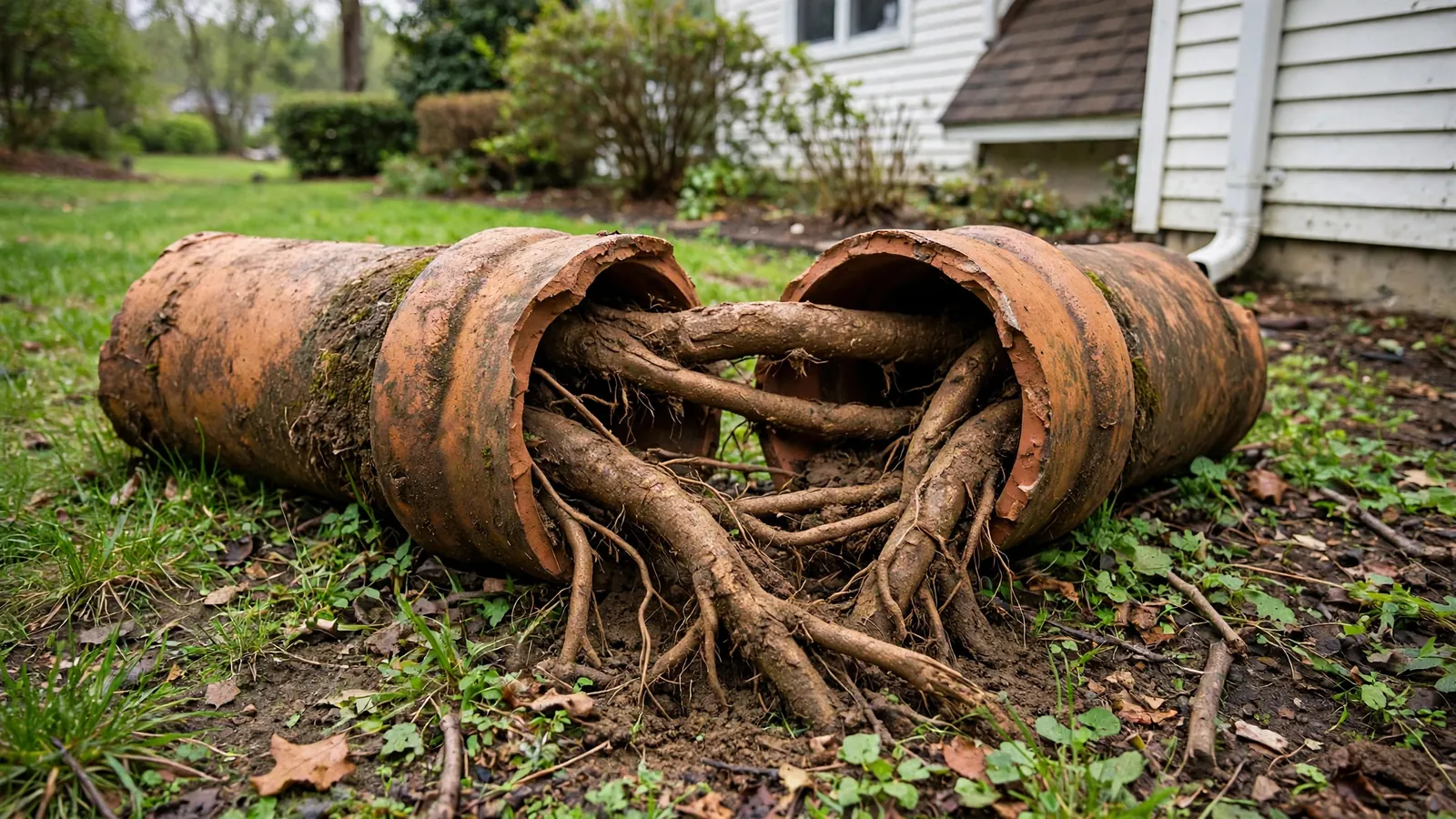
Know what your lateral is made of
The signs mean different things depending on the pipe, and Pennsylvania's older towns used four materials in sequence. Vitrified clay, jointed every few feet, serves most homes built before the 1970s and fails at its joints. Cast iron, common from the early 1900s through the 1960s, scales and thins from inside. Orangeburg, a tar and fiber pipe used from the 1940s into the early 1970s, softens and goes oval with age. PVC, the modern standard, fails mainly from ground movement and poor bedding rather than age.
If your house predates 1980 and the lateral has never been replaced, you own one of the first three, and its remaining life is a question a camera can answer in half an hour. Everything below is read most accurately with your material in mind.
Sign one: backups and slow drains with a pattern
A single clog is an event. A clog that returns on a schedule is a diagnosis. Lines that back up every spring are hosting roots that grew all season. Lines that slow in wet months may have a crack admitting groundwater and soil. Lines that fail when guests arrive are bellied or undersized for the load, holding a permanent pond that a full house overwhelms.
The pattern is worth reporting precisely when you call: which months, which fixtures first, how long since the last clearing. That history, plus a camera run, separates the line that needs cleaning from the line that needs repair, a difference of thousands of dollars in either direction.
- Backups returning within months of a cleaning
- Several fixtures slowing at the same time
- Gurgling in one fixture when another drains
- Floor drain water after laundry or heavy rain
- Sewage odor outdoors along the line's path
Sign two: the yard starts reporting
A leaking lateral waters and feeds the soil above it. The classic sign is a strip of lawn that stays green through a dry August while the rest of the yard browns, tracing the pipe from house to street. The darker sign is settlement: a dip you feel with the mower, a walk that tilts, soil washed into the pipe leaving voids that eventually announce themselves.
Inside, the yard's report has a twin. New cracks in a basement floor or foundation wall near the line's exit, or a slab corner dropping, can mean escaping water is eroding support. Plumbers and foundation companies both get these calls; the camera decides whose problem it is, and it is cheaper to ask the pipe first.
Sign three: smells and sounds inside the house
Sewer gas finds the paths that water sealed off. Odor that comes and goes with the weather can mean a cracked vent section, a dry trap in a little used drain, or waste standing in a bellied line close enough to breathe through a weak seal. A basement that smells after rain often has a floor drain trap evaporated or a backwater valve stuck open.
Sounds testify too. A toilet that gurgles when the tub drains is reporting a shared obstruction or a venting failure downstream. Fixtures should be strangers to each other; when they start commenting on each other's business, the main line is the topic.
What to do with the signs: the camera rule
Every sign in this guide converges on one recommendation: before paying for a second cleaning of the same line, pay once for a camera inspection. The camera travels the lateral, records the material, the joints, the bellies and the roots, and a locator marks the path and depth on the ground above. Sewer repair in this region typically runs $1,300–$5,800, and the spread between a spot repair and a full replacement is decided entirely by what that footage shows.
With footage in hand, the options price themselves: maintain a sound line on a schedule, line a jointed but round one, excavate the failed sections of the rest. Without footage, every quote is a guess wearing a number. Older Pennsylvania homes deserve the evidence first, because their pipes have been keeping secrets the longest.