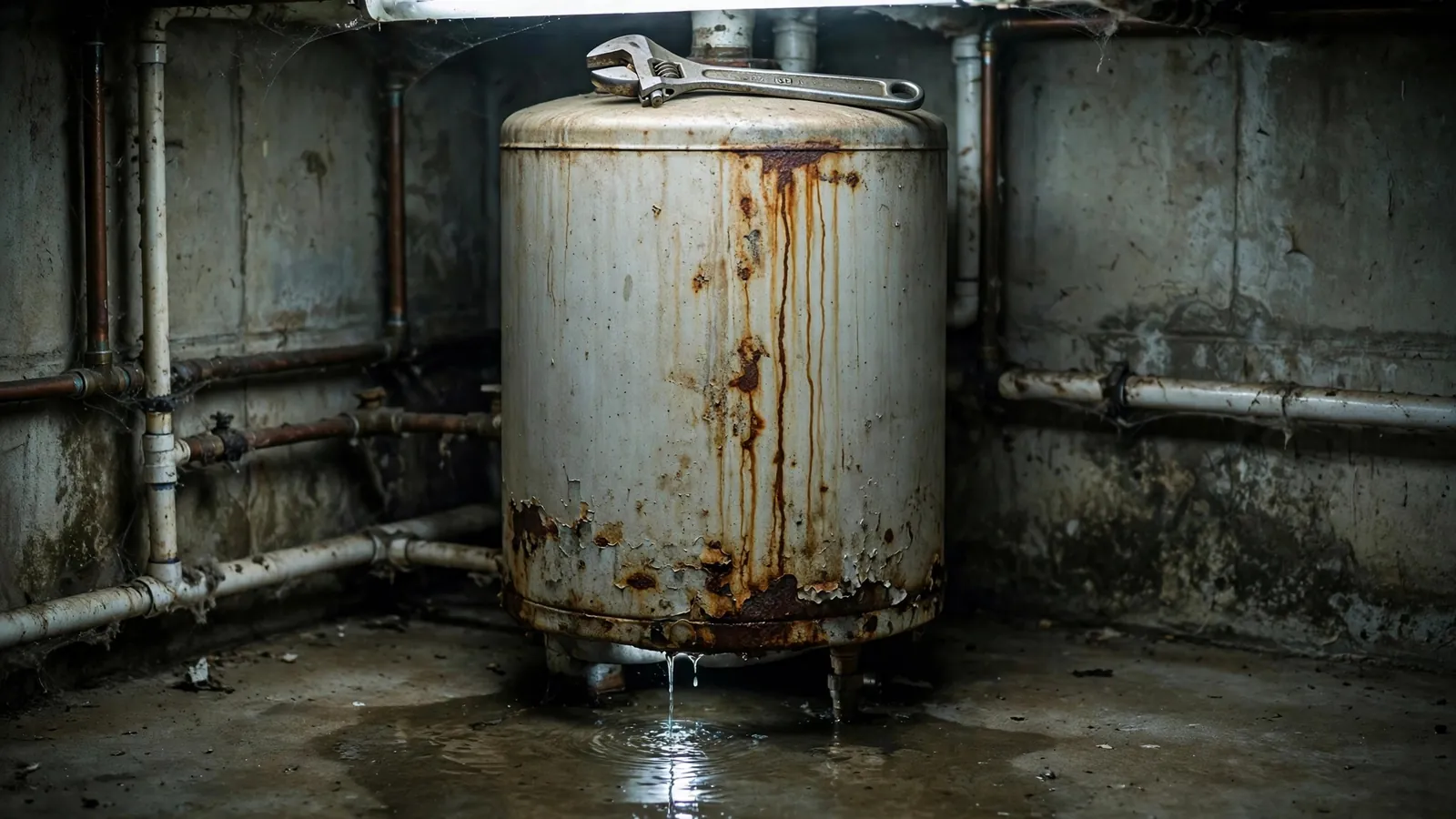
First, find out what is actually leaking
Water at the base of a heater has four common sources, and only one of them condemns the tank. A temperature and pressure relief valve can weep, from age or from excess pressure in the system. Inlet and outlet fittings can drip at their threads. A drain valve can seep past its washer. And the tank itself can leak through a corroded seam or weld, which no part replaces.
Dry the area, then watch where the first new water appears. A drip that starts at a fitting or valve is a repair. Water emerging from the tank jacket's seams, or rust streaking from under the unit, is the tank announcing the end. If the flow is heavy, close the cold inlet valve on top of the unit and cut its power or gas before investigating further.
The age test, and how to read it
Every tank carries a data plate with its serial number, and the serial encodes the manufacture date, usually in its first digits as a month and year or a year and week, with the pattern varying by brand. In South Central Pennsylvania's hard water country, a tank's honest life expectancy is eight to twelve years, toward the low end for units never flushed.
Apply the test plainly. A repairable part failure on a heater under eight years old, with no rust in the hot water, is a repair. The same failure past ten years, or at any age with rust colored water, is the opening of a replacement conversation. Between those poles, the price of the repair against the price of replacement decides, which is the next section.
- Under 8 years, no rust: repair is usually right
- Over 10 years, or rust in the hot water: lean replacement
- A leaking tank seam is never a repair, at any age
- A second major failure within a year argues for replacement
- Never flushed in hard water: subtract two years of expected life
The math, with real corridor numbers
Water heater repairs in this region typically run $220–$650: elements, thermostats and thermocouples at the low end, gas valves and control systems at the top. Replacement, sized and vented correctly, runs $1,200–$3,200 depending on capacity, fuel and access. The trade's working rule, used honestly, is that a repair approaching half the cost of replacement on a heater past ten years is usually money spent delaying the inevitable.
Run your own version of the math. A $300 element repair on a seven year old tank buys perhaps four more years: cheap years. A $550 control repair on an eleven year old buys perhaps one: an expensive year, and the replacement still arrives at the end of it, possibly as an emergency at emergency prices. The calm season replacement, chosen rather than forced, is nearly always the cheapest version of the same appliance.
Symptoms that are not the tank's fault
Several classic complaints belong to parts, not tanks. Lukewarm water or running out early often means a failed lower element or a dip tube that has crumbled, both repairable. Rumbling and popping is sediment, curable with a flush when the tank is otherwise sound. A pilot that will not stay lit is usually a thermocouple or a dirty assembly. Rust colored water only from the hot side, on a younger unit, can be a spent anode rod doing its job one last time; the rod is replaceable and cheap insurance.
The exception that proves the rule is pressure trouble. A relief valve that discharges repeatedly, or water far hotter than the thermostat setting, means controls are failing at their safety work. Those are shut it down and call symptoms, not watch and wait symptoms, at any age of heater.
If you replace: decisions worth a minute
Replacement is a ten year decision made in an afternoon, so spend a minute on the choices. Size by your household's biggest hour, not its bathroom count; a family that outgrew a 40 gallon tank should not buy another one. Consider recovery rate and, for larger households, whether tankless earns its conversion cost, remembering that hard water demands treatment or disciplined descaling for tankless units here.
Whoever installs it, get two habits in writing before they leave: the flush schedule and the anode check year. In this region those two appointments are the difference between a heater that dies at eight and one that is still working, unremarked, at thirteen. The best water heater is the one you never think about, and thinking about it twice a decade is how you get one.